How to Organize Under the Kitchen Sink, Pipes and All
A step-by-step way to sort the cabinet under your kitchen sink: empty it, check for leaks, measure around the pipes and pick storage that fits.

To organize under the kitchen sink, take everything out, fix any leak, and keep only what you use at the sink. Then measure the space on each side of the pipes and choose storage that fits those gaps, with the things you use every day at the front.
The whole job takes an afternoon. The steps below work for any sink cabinet, including the ones with a garbage disposal taking up the middle.
What you need
- A trash bag and a box for things that belong in another room
- A towel, a mild cleaner and a dry cloth
- A tape measure and a pencil
- Your storage, once you’ve measured (step 4)
1. Empty the cabinet completely
Take every bottle, bag and sponge out and set it on the counter or the floor. It’s tempting to sort in place, but an empty cabinet is the only way to see the whole space, the pipes and any water damage.
Group what comes out as you go: dishwashing, cleaning sprays, trash bags, and everything else.
2. Check for leaks and wipe it down
With the cabinet empty, look at the bottom of the cabinet and along the pipes. Warped wood, water rings or a musty smell mean a slow leak. Run the water for a minute and watch the joints and the trap, the curved pipe under the drain.
Fix a leak before anything goes back in. Then wipe the cabinet floor, let it dry with the doors open, and find the two shutoff valves at the back. They need to stay easy to reach.

3. Sort what you took out
Make three piles:
- Keep under the sink: dish soap refills, sponges and brushes, dishwasher detergent, one all-purpose spray, rubber gloves, trash bags and a small bucket.
- Move somewhere else: food, paper towels you don’t want damp, tools, light bulbs and anything you use less than once a month.
- Toss: empty bottles, dried-out sponges, duplicates of the same cleaner and anything you can’t name.
What’s left is usually a third of what came out. That’s the amount the space can hold well.
4. Measure around the pipes
A standard sink base cabinet is 36 inches wide, 24 inches deep and 34.5 inches tall on the outside, but the space inside is smaller once you take out the frame, the door hinges and the pipes. Measure your own:
- The width, depth and height of the open space on the left of the drain pipe.
- The same on the right.
- The height from the cabinet floor to the bottom of the trap or the disposal, if you have one.
- The width of the door opening, since everything has to fit through it.
Write the numbers down. They decide what you buy, and the bin size calculator turns them into the container sizes that fit.
5. Choose storage that fits the gaps
Build the space around the pipes instead of fighting them:
- Narrow bins or pull-out drawers on each side of the drain. A drawer you slide out is easier to reach than a bin at the back.
- A U-shaped shelf that wraps around the drain pipe, so the space above and around it holds a second level.
- A tension rod across the top of the cabinet. Hang spray bottles from it by their triggers and the floor stays free.
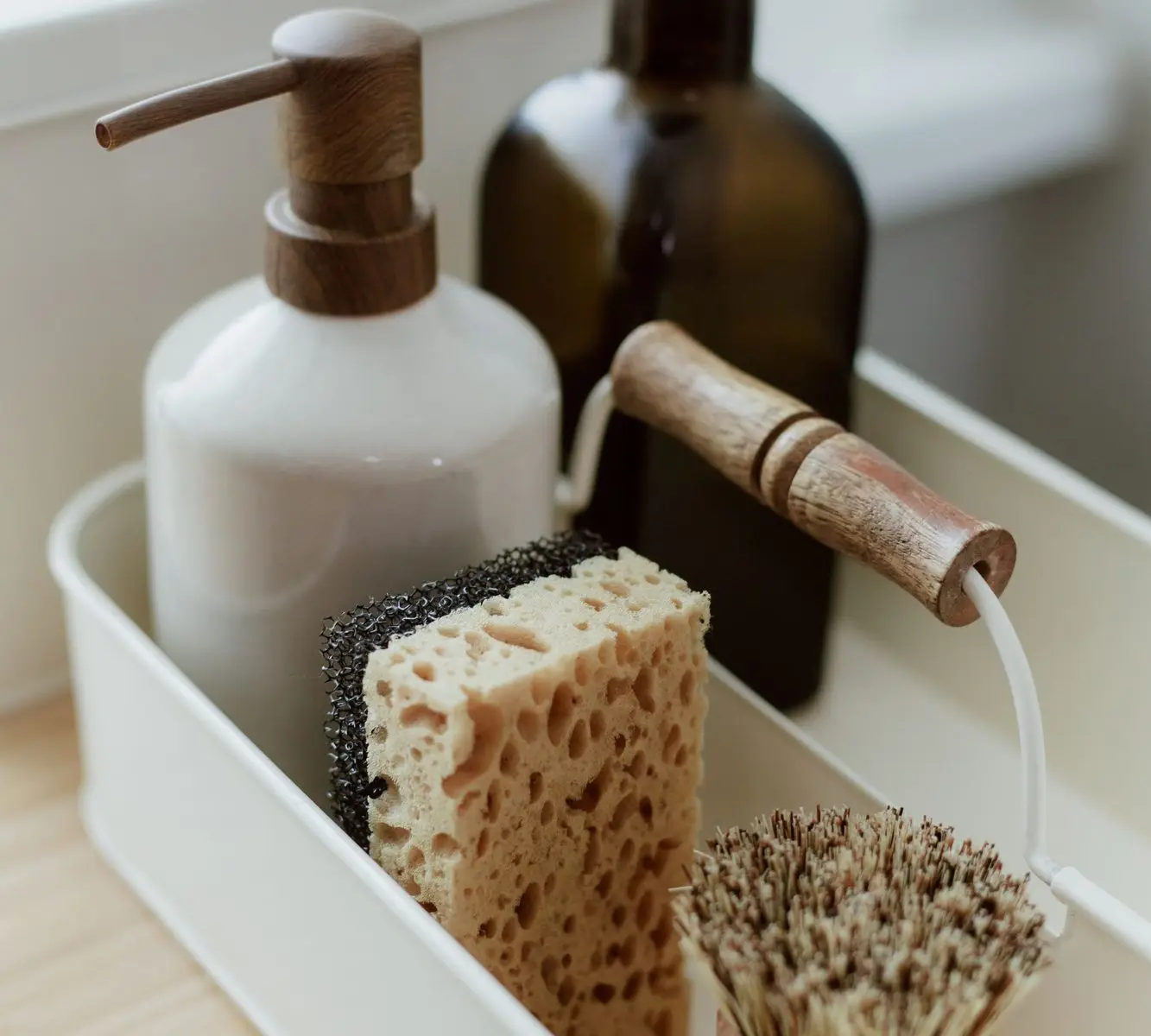
- A caddy with a handle for the cleaning supplies you carry around the house.
- A door rack for sponges and brushes, if the door closes with it in place. Check the hinges and the pipes before you mount it.
- A waterproof mat or tray on the cabinet floor, so a drip never reaches the wood.
Keep everything a little smaller than your measurements, so it slides in and out without catching on a pipe or the door frame.
6. Put things back by how often you use them
The front of the cabinet is for what you reach for every day: dish soap, sponges and the dishwasher detergent. Refills and backups go behind them or in a pull-out drawer. Trash bags fit flat against a side wall or in a slim bin by the door.
Keep the shutoff valves and the trap clear, so you can reach them without moving anything.
7. Make it safe for kids and pets
If young children or pets live with you, add a child-safety latch to the cabinet doors or move the cleaning products to a high, locked cabinet. Keep each product in its original container, never mix cleaning products, and save the Poison Help line, 1-800-222-1222, in your phone.
Mistakes that undo the work
- Buying bins before measuring. The pipes decide the sizes, and most bins sold as “under sink” won’t fit every cabinet.
- Blocking the shutoff valves. In a leak, you need them in seconds.
- Storing paper goods on the cabinet floor. One drip ruins them; keep them in a lidded bin or another cupboard.
- Keeping a backup of everything. One refill of each item is enough under the sink; the rest can live in a closet.
Keep it sorted
Once a week, when you take out the trash, put back anything that has wandered and glance at the pipes. Once a month, wipe the floor of the cabinet and toss empties. A quick look while you restock is the easiest way to catch a leak early.
Save this for later
Pin it to a board so it's there when you're ready to start.
Save to Pinterest(opens in a new tab)Make it easier
Free tool
Enter the width, depth and height of a shelf, a drawer or a cube cubby, and see which standard bins and baskets fit, how many, and how they line up.
Frequently asked questions
What should you keep under the kitchen sink?
Keep the things you use at the sink: dish soap refills, sponges and brushes, dishwasher detergent, a spray cleaner, rubber gloves, trash bags and a small bucket. Food, paper goods that can't get wet, and anything you rarely use belong somewhere else.
How do you organize under a sink with pipes in the way?
Measure the open space on each side of the drain pipe and above the trap, then use narrow bins or pull-out drawers on the sides, a U-shaped shelf that wraps around the pipe, and a tension rod across the top for spray bottles. Leave the pipe itself and the shutoff valves clear.
Is it safe to store cleaning products under the kitchen sink?
Only if children and pets can't get to them. With little ones at home, add a child-safety latch to the cabinet doors or move the products to a high, locked cabinet. Keep every product in its original container and never mix them.
How do you protect the cabinet floor from leaks?
Line the floor with a waterproof mat or a shallow tray, keep anything that can't get wet in a lidded bin, and look at the pipes when you restock. A dry, clear floor also makes a new leak easy to spot.